
How to Kill Your Family is a razor‑sharp, darkly comic revenge novel that follows Grace Bernard, a woman systematically eliminating her estranged billionaire family while narrating her story from a prison cell. It’s brilliantly written, deeply cynical, very funny in a vicious way, and capped with a twist that lingers long after you close the book.

Overview and Rating
I’m giving How to Kill Your Family a 4.75 out of 5 because it delivers exactly what it promises: a viciously entertaining, morally queasy, and stylishly written story that keeps you hooked from the opening line to the final twist.
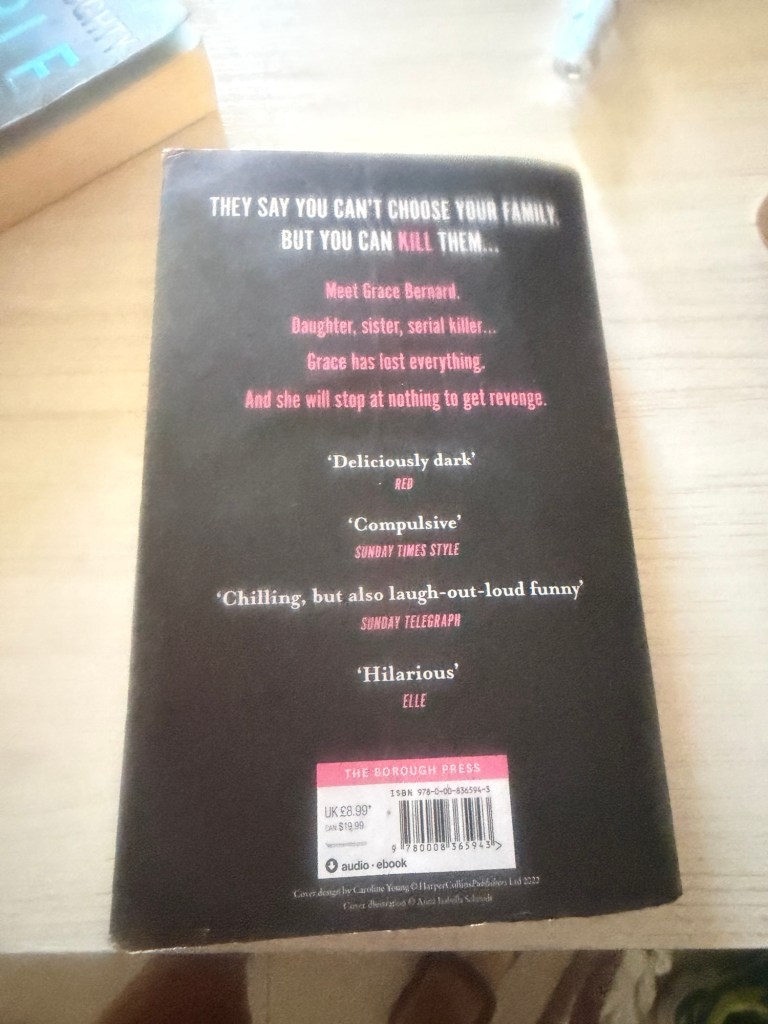
Plot Summary (Spoiler‑Aware)
Grace Bernard opens the book from her cell in an all‑women’s prison, calmly explaining that she is serving time for a murder she didn’t commit—despite the fact she has successfully killed six people. With cool detachment and biting humour, she decides to use her prison time to write down exactly how she did it, and why.
Grace is the illegitimate daughter of Simon Artemis, a phenomenally wealthy, image‑obsessed businessman who refused to acknowledge her and left her and her mother in poverty. After her mother dies young, worn down by illness and financial strain, Grace learns the truth about her father’s identity and channels her grief into a meticulous plan: she will annihilate the entire Artemis clan, one family member at a time, and only then will she come for Simon himself.
The novel moves back and forth between Grace’s present in prison and her past as she hunts down her targets: privileged siblings, smug relatives, and hangers‑on who orbit the Artemis money. Each murder is tailored to its victim—sometimes staged as an accident, sometimes as a crime of passion, always executed with unnerving precision and a deadpan running commentary on modern life, wealth, and hypocrisy.
While Grace is cool and methodical, the narrative is laced with caustic observations about influencer culture, performative charity, “good” rich people branding, and the absurdities of modern London society. The tension comes not just from whether Grace will succeed in her revenge, but from the irony that she ends up imprisoned for the one killing she didn’t commit, even as her real crimes go undetected.
The final act delivers a twist that reframes Grace’s swaggering control and forces you to reconsider just how secure she ever really was. The ending feels deliberately unsettling, underscoring the book’s interest in moral ambiguity, unfair systems, and the gap between who tells the story and who actually wins.
Tone, Style, and Dark Humour
This is very much a character‑driven, voice‑led novel; if you enjoy a strong, sardonic narrator, Grace is going to hook you from the start. She’s not “likeable” in a conventional sense—she’s judgmental, ruthless, and often cruel—but her commentary on class, privilege, and performative morality is so sharp that you may find yourself unwillingly on her side.
The humour is jet‑black: you’re laughing at funeral mishaps, social media absurdities, and the ridiculousness of the wealthy, often in the same paragraph as a cold‑blooded killing. Mackie balances this with a slow‑burn pacing that focuses less on constant thriller beats and more on the psychology of resentment, entitlement, and what years of quiet fury can do to a person.
Characters and Themes
Grace herself is the main event: an anti‑heroine who sees murder as logical, even tidy, justice for the neglect and cruelty she and her mother endured. Her voice is full of contradictions—self‑aware yet blinkered, funny yet chilling, morally lucid about everyone else while blind to her own monstrosity—which makes her compelling even when she’s appalling.
The Artemis family function as a gallery of modern, media‑friendly aristocrats and new‑money caricatures: influencers, philanthropists, social climbers, and corporate saints whose public ethics mask deep selfishness and vanity. Through them, the book skewers class inequality, inherited wealth, PR‑polished compassion, and the idea that a good public image can erase harm.
Running beneath the satire is a very human story about loss, abandonment, and what happens when grief calcifies into rage instead of healing. Grace’s trajectory asks where the line sits between personal responsibility and structural injustice: is she a monster shaped by systems, or someone who actively chooses monstrosity and dresses it up as justice?
The Twist and Ending (No Detailed Spoilers)
Without spelling out the final reveal, the twist undercuts the fantasy of total control that Grace has been selling you all along. It highlights how fragile her carefully constructed narrative always was and reinforces the book’s interest in power, luck, and who ultimately gets to walk away clean.
Some readers will find the ending abrupt or even infuriating, especially if they’re expecting conventional thriller closure. For me, it felt like a gutsy choice that keeps the story lodged in an uncomfortable, morally murky space rather than tying things up with a bow—fitting for a book this dark and sardonic.
Who This Book Is For
You’ll likely love How to Kill Your Family if you enjoy:
• Darkly comic crime or psychological fiction with a morally grey narrator
• Social satire that skewers the super‑rich, influencer culture, and performative “goodness”
• Slow‑burn narratives focused on character voice rather than wall‑to‑wall action
It may not be for you if you need a traditionally satisfying, neatly resolved ending, or if you prefer crime novels where you root for the detective instead of the murderer.
You can buy the book here

